
The Super Eagles of Nigeria will miss out on a second successive World Cup, and there is enough blame to go around. The country, popularly referred to as the “Giants of Africa,” have fallen flat on their faces, reaching a whole new low.
Fans are currently grappling with this reality following a chaotic and disjointed qualification campaign.
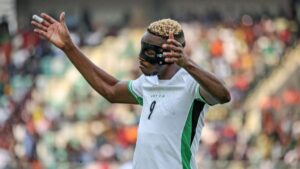
Despite boasting world-class talent like Victor Osimhen, Ademola Lookman, and Alex Iwobi, the team could not secure one of the expanded 48 places at the 2026 finals, falling 4-3 on penalties to the DR Congo in Africa’s play-off final on Sunday night.
This disappointing result means the fifth-ranked side in Africa will be absent when the tournament kicks off in the United States, Mexico, and Canada next year—a country where Nigeria first exploded onto the global scene in 1994.
The Collapse on the Pitch
The play-off final highlighted the Super Eagles’ instability. After Frank Onyeka put Nigeria ahead early, Meschack Elia equalized just after the half-hour mark. The pivotal moment came when talisman Osimhen, who had scored eight goals in seven qualifiers, left injured at half-time, and the Super Eagles barely threatened thereafter.
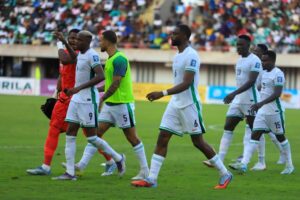
The penalty shootout cemented the defeat, with Calvin Bassey, Moses Simon, and Semi Ajayi all failing to convert. The ensuing frustration was so intense that coach Eric Chelle made the “surreal” move of accusing a member of the DR Congo technical staff of “voodoo” while his side was taking penalties—a rare allegation in modern African football.
A Campaign Defined by Chaos
The qualification journey was undermined by continuous off-field instability. The squad endured two managerial changes and struggled to perform consistently without Osimhen, earning only 4 points from 15 possible when the star striker was sidelined.
The early campaign under Jose Peseiro saw disappointing 1-1 home draws against Lesotho and Zimbabwe. His successor, former Nigeria winger Finidi George, had a short-lived and damaging spell, overseeing a home draw against South Africa and a 2-1 loss in Benin that left the team with just three points from four games.

The final administrative failure came just days before the crucial play-offs when players and technical staff boycotted training in Morocco over unpaid allowances and match bonuses. While the issue was resolved, leading to a strong 4-1 semi-final win against Gabon, supporters viewed the dispute as symptomatic of deeper governance issues within the Nigeria Football Federation (NFF).
Moving Forward: What next for the Super Eagles & NFF?
The immediate task is refocusing, as the 2025 Africa Cup of Nations campaign begins in just 36 days. The defeat has served as a “wake-up call,” demanding a structural reassessment of the NFF’s operations and its long-term strategy.
Coach Chelle’s position is now under intense scrutiny, as World Cup qualification was the primary target of his contract.
Whether the NFF opts for yet another managerial change or commits to a more long-term blueprint for development, the national expectation must shift from relying on raw talent to establishing foundational work in local football infrastructure.
Nigeria’s future now depends on the NFF delivering a clear path to return to the global stage by 2030.